
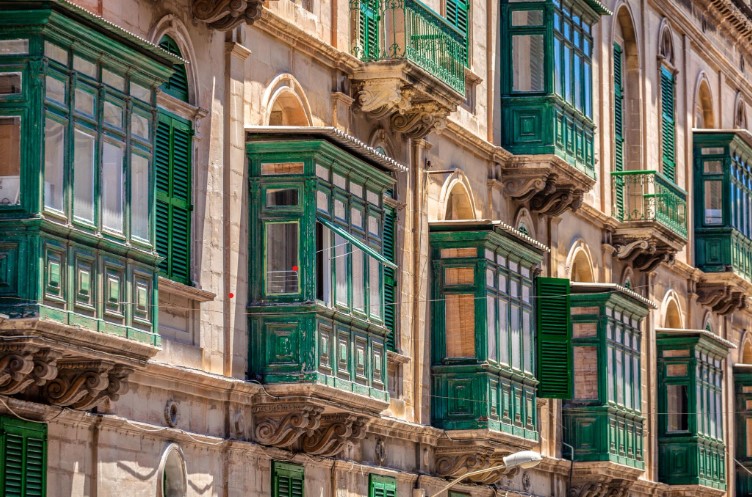
Walk through the narrow streets of Valletta, Mdina, Birgu or Rabat, and one architectural feature immediately catches your eye. Rows of colourful wooden balconies seem to float above the honey-coloured limestone buildings, creating one of Malta’s most recognisable and photographed streetscapes.
Known locally as the gallarija, these enclosed wooden balconies have become an enduring symbol of Malta. But beyond their striking appearance lies a fascinating story of history, culture and clever design that has shaped the island for centuries.
A Balcony with a Story
 Many visitors assume that Malta’s balconies were built simply to decorate buildings. In reality, they were designed with a purpose.
The gallarija evolved from the Arabic mashrabiya — an enclosed balcony commonly found throughout North Africa and the Middle East. Malta’s unique position at the crossroads of Mediterranean civilisations meant that architectural influences from both Europe and the Arab world blended together over time. Later, during the rule of the Knights of St John, these ideas were refined into the elegant balconies we admire today. By the 18th century, they had become one of the defining features of Maltese Baroque architecture.
Today, the gallarija is more than an architectural detail; it has become an icon of Maltese identity.
Why Are They Enclosed?
Unlike the open balconies found across much of Europe, Malta’s traditional balconies are enclosed with timber frames and glass windows.
This wasn’t simply a stylistic choice.
The enclosed design offered several practical advantages:
- Protection from the strong Mediterranean sun.
- Shelter from wind, rain and sea salt.
- Better airflow during the hot summer months.
- Increased privacy while allowing residents to observe daily life outside.
Long before air conditioning existed, these balconies acted as a natural climate control system, keeping homes cooler while capturing sea breezes.
The Perfect Place to Watch Life Go By

For generations, the gallarija became the social heart of many Maltese homes.
Before televisions, smartphones and social media, people spent hours sitting behind their balcony windows watching the rhythm of village life unfold below.
Neighbours exchanged greetings.
Children played in the streets.
Religious processions passed beneath.
Markets came alive.
Fiestas filled the air with music and colour.
The balcony offered a front-row seat to everyday life without ever leaving home.
Even today, if you stroll through Malta’s older towns, you may notice residents quietly observing the street from behind partially opened shutters—a tradition that has survived for centuries.
Every Colour Has Its Own Character
One of the first things visitors notice is the incredible variety of colours.
Deep green remains the most traditional choice, but you’ll also find balconies painted in rich blues, burgundy reds, mustard yellows and crisp whites.
Originally, colours often reflected the personal taste of the homeowner or matched the surrounding architecture rather than carrying any official meaning.
Combined with Malta’s warm limestone buildings and bright Mediterranean light, these vibrant balconies create one of the island’s most distinctive visual identities.
More Than Wood and Glass

Look closely and you’ll discover that every balcony tells a different story.
Some rest on beautifully carved limestone corbels decorated with flowers, shells or mythical creatures.
Others feature intricate timber craftsmanship, decorative mouldings or elegant proportions that reflect the architectural styles of their period.
No two historic streets are exactly alike.
This individuality is one of the reasons Malta’s historic towns continue to captivate architects, photographers and travellers from around the world.
Where Can You See the Most Beautiful Gallarija?

If you’re looking to admire Malta’s finest traditional balconies, these towns should be at the top of your list:
Valletta — The capital offers perhaps the greatest concentration of historic gallarija, particularly along Republic Street, Merchants Street and the quieter side streets.
The Three Cities (Birgu, Senglea and Cospicua) — Less crowded than Valletta, these historic maritime towns preserve countless authentic balconies full of character.
Mdina — Malta’s Silent City combines noble palaces with elegant balconies overlooking peaceful alleyways.
Rabat — Traditional homes blend beautifully with village life, creating a timeless atmosphere.
Gozo’s Victoria (Rabat) — The island’s capital showcases charming examples mixed with quieter, more rural architecture.
Preserving a National Treasure
As Malta continues to modernise, preserving its architectural heritage has become increasingly important.
Many historic balconies require specialist restoration using traditional timber techniques and carefully selected colours that respect the original design.
Across Valletta, the Three Cities and numerous Urban Conservation Areas (UCAs), restoration projects continue to protect these unique architectural features for future generations. Conservation efforts recognise the gallarija not simply as a balcony, but as an essential part of Malta’s cultural landscape.
A Symbol of Malta

For locals, the gallarija is a familiar part of everyday life.
For visitors, it quickly becomes one of the island’s most memorable sights.
For homeowners, it represents craftsmanship, heritage and timeless character.
Whether painted emerald green, royal blue or deep burgundy, every traditional Maltese balcony tells a story—not only of the building it belongs to, but of the generations who have lived behind its wooden shutters.
And perhaps that’s why these balconies continue to capture the hearts of everyone who walks Malta’s historic streets. They are not simply architectural features; they are living reminders of the island’s remarkable history.
Buying a House with a Gallarija in Malta
What makes those buildings with such balconies even more sought after is that most of the houses are located in UCA (Urban Conversation Areas) and the Maltese government grants generous tax benefits and other schemes to preserve these along with other original Maltese features. So if you are thinking of buying such a house, you are buying a piece of Maltese history. Our boutique real estate agency offers some of the most beautiful homes with the traditional gallarija. Please feel free to contact us and we will be more than happy to find you a house with a colorful gallarija.


 Bay Steps Mansions,
 +356 2134 3047 / 2134 3053
